Nearly all business buyers today use AI to research, evaluate and make decisions, according to the 2026 Forrester report, The State of Business Buying. The challenge for marketers is to understand how AI is changing which vendors buyers consider.
While AI has not eliminated the buyer journey, it has moved more of the journey outside the company’s view. G2 reports that 69% of B2B software buyers chose a different vendor than initially planned because of AI guidance. Thirty-three percent purchased from a company they had never previously heard of, a signal of how AI is influencing the Day One decision.
AI is influencing a part of the buying decision that has historically been extremely difficult to change.
This guide shows how to identify the buyer conversations that matter most and help buyers move through them.
Back to menuof B2B software buyers chose a different vendor than they'd planned — because of AI guidance.
bought from a company they had never heard of.
AI discoverability has officially moved out of the experimental corner of marketing. Buyers are using AI to diagnose problems, explore approaches, compare options, challenge claims and prepare internal recommendations—often before they ever visit a vendor website.
Forrester’s 2027 budget planning guidance recommends that leaders spend on brand visibility in answer engines. Its related AEO guidance emphasizes real customer questions and credible voices such as customers, experts and partners. It also makes an equally important point: synthetic data should complement—not replace—real-world inputs.
That combination matters because it tells us that AI is not simply a new channel to optimize. It is a new way to understand how brand, evidence, customer language and buyer learning work together.
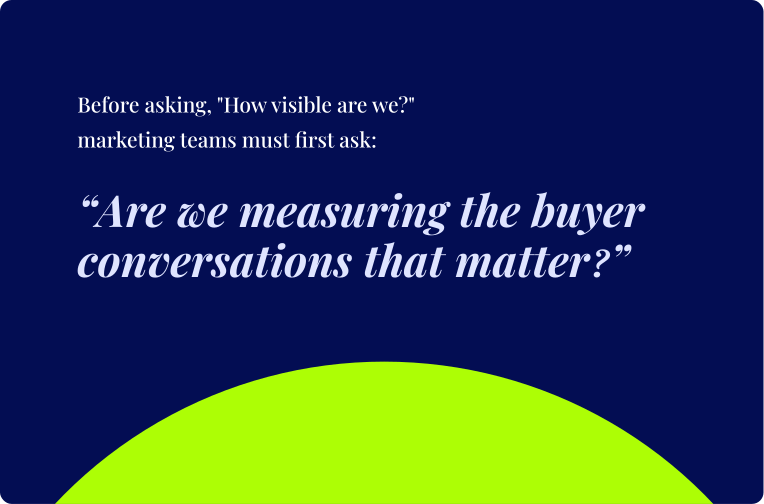
An answer-engine dashboard can tell you whether you appear, but not whether that prompt represents a commercially meaningful buyer conversation. If the original prompts reflect company assumptions rather than buyer reality, the system becomes increasingly precise at measuring the wrong thing. Because in this new environment, measuring the wrong conversation does not simply waste effort. It can create false confidence while the real buyer decision is happening somewhere else.
Back to menuBuyers begin with a situation they need to change. Companies begin with products and categories. A buyer’s journey may start when a deadline moves, a system fails, a project cannot proceed, a regulator asks a difficult question, a renewal approaches, a team becomes exhausted by a workaround or an executive expects an outcome the current operating model cannot deliver. Sellers organize around products and categories. This gap shapes everything.

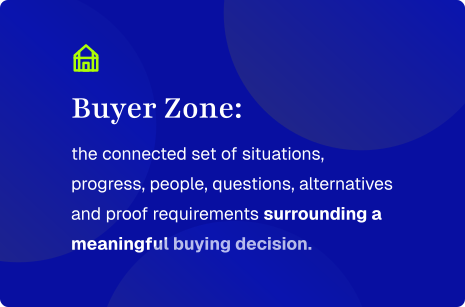
A Buyer Zone is the connected set of situations, progress, people, questions, alternatives and proof requirements surrounding a meaningful buying decision. It is a way to see the whole decision—not just the search term or prompt. A prompt is one expression of a decision. The Buyer Zone is the world that gives that prompt meaning.
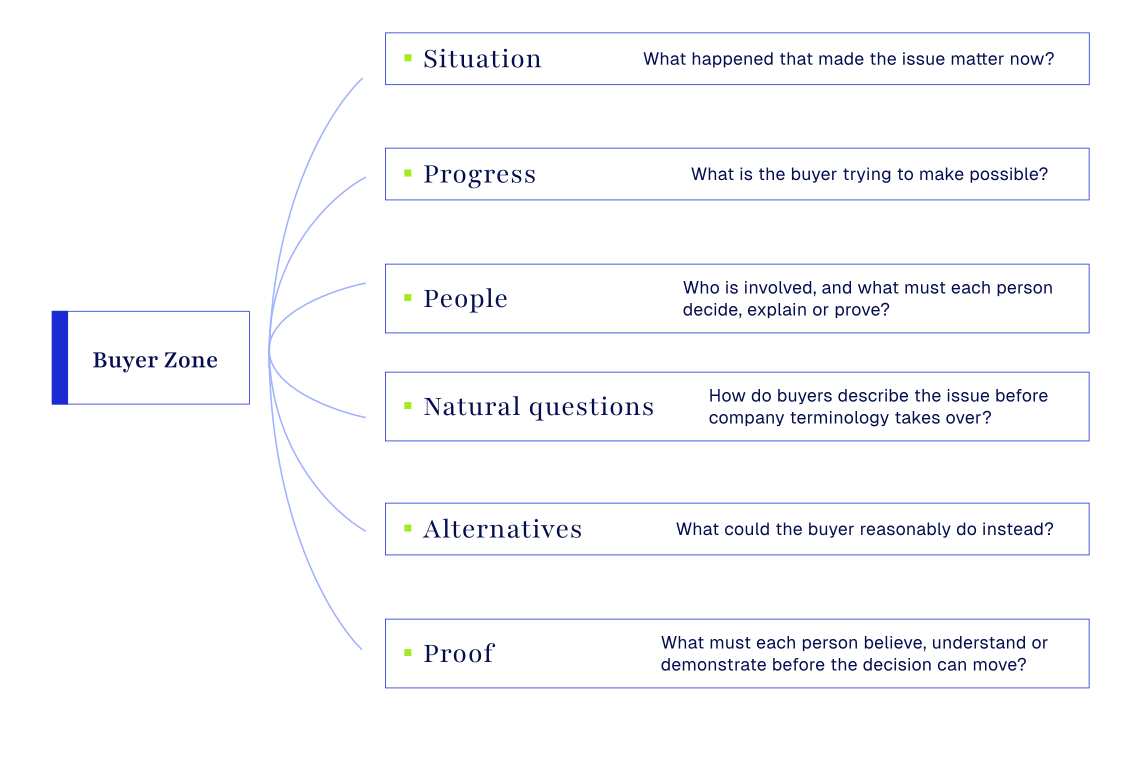
Imagine a company wants to give an AI application access to current operational data. The obvious marketing phrase might be “AI-ready data.” But the actual Buyer Zone could contain:
I call the distance between the company’s view and the buyer’s lived decision the Buyer Intelligence Gap. AI makes the gap harder to see and more expensive to ignore. Buyers now form opinions outside of spaces companies monitor, while companies turn existing assumptions into AI prompt libraries and dashboards.
The goal is not to abandon the Company Zone. Buyers eventually need product information, technical details, comparisons and a clear explanation of what you do. The goal is to understand what must happen before that language matters.

The goal is not to abandon the Company Zone. Buyers eventually need product information, technical details, comparisons and a clear explanation of what you do. The goal is to understand what must happen before that language matters.
Back to menuThe Buyer Intelligence System examines where buyers begin, what helps them move and what gets in the way. The Buyer Intelligence Gap is a framing problem before it is a measurement problem.
You cannot optimize your way out of a framing error. Once you identify the Buyer Zone, the next challenge is operational: how do you turn that understanding into decisions about where to focus, what to build and how to measure movement?
The triggers become the spine of that system. It anchors the conversation in what changed for the buyer and connects the people involved, the questions they are asking, the alternatives they are considering and the proof they need.
One global enterprise software company had organized its go-to-market strategy around a unified data intelligence portfolio. The portfolio strategy was logical, but buyers weren't entering through it.
The evidence revealed seven specific operational triggers—moments when critical data had become unreliable, difficult to access, risky to maintain or too slow to support the business. Those triggers clustered into three natural conversation doors:
The trigger opened the conversation. The portfolio expanded the opportunity.
Synthetic users helped pressure-test the language and assumptions. The products hadn't changed. The go-to-market strategy had.



The script I used with the synthetic users was very specific—I wasn't trying to understand their world broadly, but rather the exact prompts and language buyers might use when asking AI answer engines for purchase recommendations. We grounded that work in real market signals, including intent data and public buyer language from G2, Reddit, and category/product conversations, which helped us adjust messaging and content
quickly based on the findings.”

Once the triggers and Buyer Zones are established, the same triggers becomes the spine connecting three views of the buyer decision.

Are we present, understood, recommended and trusted when this conversation begins?

Is the go-to-market system giving buyers the content, proof and support they need as the conversation develops?

What is helping active buyers move — and what is causing them to stall?
Buyer Visibility starts with a buyer-conversation map: the situations, triggers, questions and decisions worth measuring. Building that map requires multiple points of view:
Only after the buyer-conversation map is established does visibility measurement become meaningful.
This reveals where the company is absent, misunderstood or missing credibility required to enter serious consideration. It also helps distinguish the conversations that belong in the measurement baseline from emerging hypotheses that should remain experimental. The goal is not to make the company louder everywhere. It is to make the company the clearest and most credible answer at the moments that matter.
Buyer Visibility shows where the important conversations are and which buyer roles participate. Buyer Alignment asks whether you’re supporting those conversations at the right level. The same trigger can create very different needs across the buying group. An executive may need to understand the business consequences. A practitioner may need to know whether the solution will work in the existing environment. A risk or compliance leader may need evidence that the decision can be defended.
The goal is not to create more content. It is the right content and proof, for the right people, around the triggers most likely to move the decision.
Buyer Alignment asks:
Buyer Commitment brings that learning upstream and looks at active decisions from the buyer’s perspective. It does not begin with how much activity an account has generated. It begins with the trigger that brought the buyer into the conversation. From there, the system examines whether the conditions required for a decision are present:


Buyer Commitment asks:
Across the pipeline, this creates a clearer view of accounts with strong decision readiness, specific addressable gaps, those requiring more validation, and those where no real decision appears to be forming.
The goal is not to make every opportunity move faster. It is to improve Commitment Velocity: helping the right buyers make the commitments required to reach a confident decision.
The first time the Buyer Intelligence System is configured, it creates a starting view. It shows which Buyer Zones and triggers matter, where the company is visible or absent, where content and proof are misaligned and which active decisions appear ready—or unable—to move. That starting view is valuable bBut it is still a snapshot. The real value begins when you use that view to create hypotheses, run focused experiments and learn from what buyers do next.


That is how the system becomes a learning system.
The baseline reflects the best available evidence at that moment. Preserve distinctions: findings grounded in buyer language carry more confidence than internal brainstorming alone. The baseline is not truth—it's your most informed starting position.
The baseline reflects the best available evidence at that moment. Preserve distinctions: findings grounded in buyer language carry more confidence than internal brainstorming alone. The baseline is not truth—it's your most informed starting position.
The experiment should address the hypothesis directly. Before launching, define what buyers should do differently if the hypothesis is correct. That response becomes your measure.
Look for converging evidence across the three views—not single signals or forced causation. The system should look for converging evidence across Buyer Visibility, Buyer Alignment and Buyer Commitment. Evidence might be recommendation rate, proof-gap resolution, or Decision Readiness movement.
Every experiment should change what the organization knows.
If the expected response appears, the hypothesis becomes stronger and the organization can expand or deepen the intervention.
If some signals improve and others do not, the hypothesis may need refinement. The organization may have identified the right problem but the wrong proof, buyer role or intervention.
If the expected response does not appear, the trigger, interpretation or proposed action may need to be reconsidered.
All three outcomes create learning: hypothesis strengthens (expand intervention), signals mixed (refine approach), no response (reconsider assumption).
Update: Buyer Zones, trigger weights, measurement baseline, content strategy, and open learning gaps.
This is where value compounds. The system no longer simply describes what is happening. It learns from market response and improves your decision-making over time.
The system isn't software. It's a shared view of your buyer. This framework is designed to work with the everyday tools your team already uses. Start at the lowest fidelity that's easy for you to work in, and build the dashboard later — not before. Start with one priority area and one learning cycle. Work through five moves.
Choose one priority area where expected movement is missing-- visibility gap, recommendation gap, engagement gap, or decision readiness gap. Pick where better intelligence will drive action, not where data is easiest.
Gather company story, customer and field evidence, open-market signals, search and intent signals, answer-engine results and synthetic-user exploration. Map where conversations happen, triggers, roles involved, questions, alternatives, proof, and your current position.
Create a credible trigger-by-persona map based on available evidence—not every signal.
Pressure test triggers before building the rest of the system around them. Internal validation (sales, customer success, product, customers) tests if triggers are recognizable and consequential. The outside-in view (reviews, search, competitive signals) shows market reality.
Separate the triggers into three groups:
Baseline → Experimental → Do not prioritize
Baseline triggers have enough evidence to anchor the system.
Experimental triggers are promising but require more validation.
Use the validated triggers as the common spine across Buyer Visibility, Buyer Alignment and Buyer Commitment.
For each trigger, establish:
Establish ownership: Maintain the Buyer Zones, challenge assumptions, connect signals and keep the learning loop moving.
Use the starting view to identify the strongest next hypothesis. Define the focused experiment, what buyers should do differently, which signals you’ll measure, when the team will review the result, and how the learning will update the system.
The experiment may strengthen a missing proof point, reframe existing content around a trigger, address an underserved buyer role, equip an internal champion or bring a missing stakeholder into an active decision.
Measure more than activity. Look for changes in recommendation, trigger-by-persona coverage, engagement from the right roles, proof-gap resolution, decision readiness and commitment velocity. Then feed the result back into the system.
Starting view → Hypothesis → Experiment → Buyer response → Learning → Updated system
Some findings will become stronger, some will need refinement and others will prove that the organization should stop investing. All three outcomes create value.
AI has not eliminated the buyer journey. It has moved more of the journey outside the company’s view and accelerated what happens there. That makes visibility important. But visibility by itself is not enough.
Forrester calls this convergence the GTM singularity: a moment when AI, changing buyer behavior and market complexity are making traditional go-to-market playbooks increasingly obsolete.
Many organizations are responding by adding AI to the same inside-out systems without determining if they’re measuring the right conversations. AI doesn't correct false positives—it makes them more convincing.
The real advantage comes from bringing the buyer’s perspective into the system: what changed in their world, where the decision begins, which questions matter, who must align, what proof creates confidence and what prevents progress.
That is the role of the Buyer Intelligence System. It gives the organization a shared view of the buyer, connects that intelligence to action and continually learns from what buyers do next.
The Buyer Intelligence System gives your organization a shared view of the buyer, connects that intelligence to action, and continually learns from what buyers do next.